
Following my first interview with the creators of Dracamar, I’m keeping the momentum going. Just as I promised there is a conversation with another studio. I managed to do a quick chat with Undercoders, the team behind the brilliant indie title Denshattack!, that launched this month and is getting great reviews. I must admit that I’m one of the players totally captivated by this title (the gameplay really kicks ass!), so I was happy to pull some strings and thanks to JF Games, we’ve got another interesting interview on RnG. You’ll find the interview below—enjoy!
repip: Hi there! Thanks for agreeing to this interview! I’ve already played for many hours Denshattack!, and I want to say right away one thing —damn, you guys delivered an amazing game! But before we dive into that, could you briefly introduce our readers to your studio’s work and what projects are in your portfolio?
Undercoders: Thank you so much! We’re Undercoders, an independent studio based in Barcelona. We’ve been developing games for quite a long time, working both on our own projects and alongside other teams and publishers.
Before Denshattack!, we developed games such as Mail Mole, Treasures of the Aegean and Koa and the Five Pirates of Mara. Although they’re quite different from one another, they all share an interest in responsive movement, speed and levels that encourage players to explore or improve their performance.
Denshattack! is our biggest and most ambitious project so far. In some ways, it feels like a natural evolution of the things we learned while making those previous games, although the premise is a bit more unique!
repip: Looking at Denshattack!, one can’t help but ask: what is your favorite country—and why is it Japan? :). The atmosphere of the turn of the millennium practically jumps out at you—that era when we looked at the Dreamcast and arcade cabinets, all while playing PlayStation at home and eagerly awaiting the massive launch of the PS2. Tokyo seemed like a Mecca for gamers. Back in Poland, we readed gaming magazines waiting for updates on the latest news, TGS, Akihabara photos, and new releases from Japan. Were you inspired by that specific period, or do you belong to a different generation—one that fell in love with Japan in a completely different way?
Undercoders: We definitely belong to that generation! Here in Spain, and particularly in Catalonia, Japanese games and anime had a huge influence on many of us while growing up.
Since the early nineties, series such as Dragon Ball, Captain Tsubasa, Kinnikuman, Ranma and Sailor Moon were regularly shown on local television. At the same time, we grew up playing Japanese arcade and console games, so that period around the Dreamcast, the original PlayStation and the launch of PlayStation 2 left a very strong impression on us.
We’ve also been fortunate enough to travel to Japan regularly since 1998. Over the years, we’ve backpacked through its different regions and fallen in love with the contrast between the enormous cities and the quiet countryside, as well as the food, landscapes, subcultures and railway system.
So Denshattack! comes from both things: the Japan we discovered through games, anime and magazines when we were younger, and the real places and people we later encountered while travelling there.
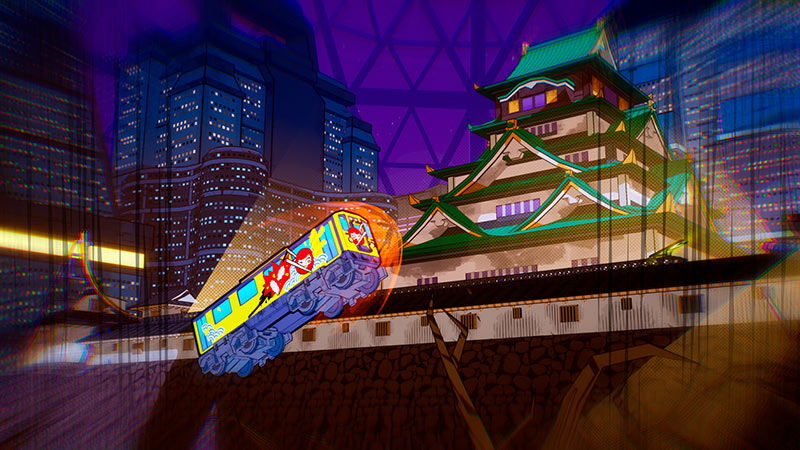
the crazy Japan form Denshattack! comes from a connection of 90s pop culture i and years of travel through Japan
repip: Setting everything else aside for a moment, I want to ask something that simply has to be asked—though I’m guessing no one else has brought it up. What is your favorite level from the Tony Hawk’s Pro Skater series? For me, it’s THPS2 and the iconic Venice Beach—mostly for the atmosphere, tbut the part with the magical bums was great too :). How about you guys? I mean, from the creators of Denshattack!, I can’t imagine you haven’t played the THPS series. Or maybe not?
Undercoders: Of course we played the series to death ha ha ha. Even though there were some cool skate games before, like California Games, Skate or Die and even Sega’s Top Skater, THPS was the first “true skateboard game” for us. It was just revolutionary and we were glued to the screen from the moment we could get a hold of it.
Personally, I have the very first Warehouse level burnt in my mind, as it was the first impression of the game and it felt so real! I just have so many memories of it… but if I had to choose one to replay over and over again, it would probably be the airport level in THPS3. There was just so much fun stuff to do!
repip: As I played through the game and discovered one crazy challenge after another, one question kept coming to mind: during development—while brainstorming levels and tasks—was there ever an idea which you deemed too crazy to implement? Because it feels like there were no limits at all, and you just threw in everything you ever dreamed of, without holding back.
Undercoders: Our general philosophy during development was to ask ourselves “why not?” whenever somebody suggested an idea that sounded exciting. When your starting point is a wanman train performing skate tricks, it becomes quite difficult to reject something simply because it sounds too ridiculous!
That doesn’t mean every idea made it into the game. We discarded many mechanics and situations because they didn’t work properly, were too confusing or created technical and production problems and challenges. The ideas most likely to be removed were usually those that changed the train’s physics so much that they broke the metrics of the levels.
So there were few to none ideas that were considered just “too crazy” to implement. The real question was always whether we could turn them into something fun, readable and affordable to produce.
repip: As we could see from the first materials released last year, the game is wild—yet, thanks to its originality, it stands apart from the rest of the market in a unique way. While today’s games might seem to offer freedom of exploration, they often rely on repeatable patterns. Your game may not offer quite as much freedom, but it certainly avoids those repeatable patterns. I think that taking such a risk requires courage and faith in the project. I’m truly grateful for that, as it gives me hope that great arcade-style games are still possible to do. Did the decision to create a game like this feel like a risk to you, or was it quite the opposite?
Undercoders: It definitely felt like a risk, but the truth is that most indie projects are? The initial reaction from the team was that the idea sounded silly and later we spent more than a year being rejected by publishers. Many people thought it was a funny gimmick, but had doubts that it could become a complete game.
At some point, we did ask ourselves whether we should abandon it and work on something more conventional. But every time we improved the prototype, tested it with players or added another layer to the design, we became more convinced that there was something valuable behind the unique premise.
As an independent studio, originality is also one of the few ways we have to stand out in a market full of games with very high production values. Making something unusual doesn’t guarantee success at all, but creating a game that looked and felt like many others would have been a different kind of risk.
We believed the concept could work, but we also tried to be realistic about our limitations, reduced the risks where possible and proved the idea through prototypes rather than relying only on enthusiasm.
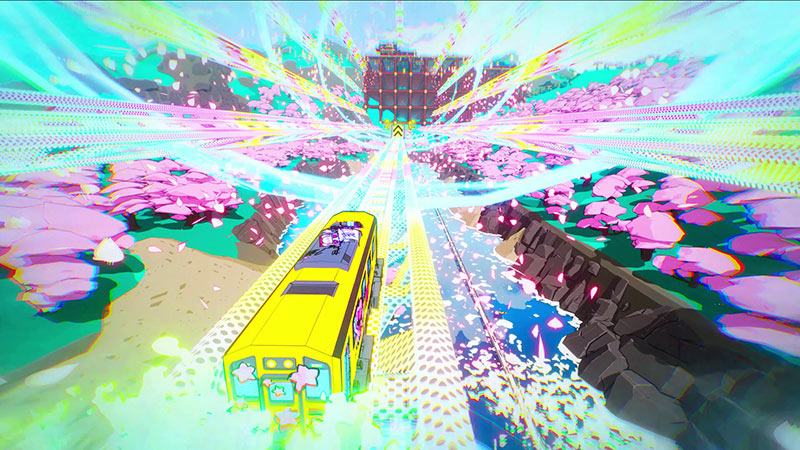
It wasn’t easy to find a publisher for such an original and crazy game concept
repip: You’re a studio from Barcelona, and the game offers Catalan as a language option—something I really appreciate; I like it when a studio highlights its roots. That raises a question for me, though, since I’ve previously interviewed the Catalan team Petoons Studio: did you consider incorporating elements of the „Tió de Nadal” into Denshattack!—and will we see a pooping log in there? It seems like a perfect fit!
Undercoders: Ha ha ha, that’s a good question! While we did incorporate Catalan language as a choice (like in our previous games), for this title we’ve decided to focus on being faithful to Japanese culture as the game takes place there. It would be funny though if somebody would encounter a Tió!
repip: Denshattack! has a really complex system—all those drifts, jumps, tricks, wall-riding and rainbow tracks—that demands focus from the player. I’m curious, though, about how complex the process of integrating and testing these elements was on your end. I know you changed the release date; was the gameplay testing—verifying that it felt satisfying—time-consuming, or did it all come together naturally and smoothly?
Undercoders: It was a very long and iterative process. Almost every mechanic in the game was reworked many times, and the basic control scheme alone took us months to refine. The first versions were more complex, with more inputs, combinations and sequences required to control the train. Through internal testing, focus groups, public demos and events, we observed where players struggled, what felt intuitive and which mechanics caused frustration. From there, we simplified the controls while preserving the depth of the system.
Adding new mechanics was also complicated because they had to remain compatible with all the stages that had already been created. Something that worked well in a new level could easily break the metrics, shortcuts or difficulty of an earlier circuit, so every addition required a lot of testing across the whole game. Public playtests were especially useful. Players found trick combinations and scoring exploits we hadn’t anticipated, and their feedback helped us adjust tutorials, difficulty spikes and the value awarded to certain risky moves.
So it required a lot of trial and error, but we think that process was essential to make such a large moveset feel accessible and satisfying.
repip: We’re talking about an complex system and a unique style, but the music is also magnificent. What guided your choices for the soundtrack? I see it’s available for purchase, and it is simply massive. How many people did Denshattack! actually require to create?
Undercoders: From the beginning, we knew the soundtrack would be fundamental to the personality and energy of Denshattack! Fortunately our publisher, Fireshine Games, was very aligned with us on that.
The first step was finding somebody who could lead the musical direction, and we proposed Tee Lopes because we loved his work on games such as Sonic Mania and Teenage Mutant Ninja Turtles: Shredder’s Revenge. Fortunately, he liked the project and joined alongside Sean Bialo and Andrew One, who became the core of the music team.
We worked together on several demos until we found what we considered the “Denshattack sound.” From there, we began contacting guest musicians. We had a very long wish list, and the composers themselves also suggested artists they had worked with or wanted to collaborate with, with a particular effort to involve Japanese musicians. The whole thing gradually became much bigger than we initially imagined and couldn’t be happier with it!
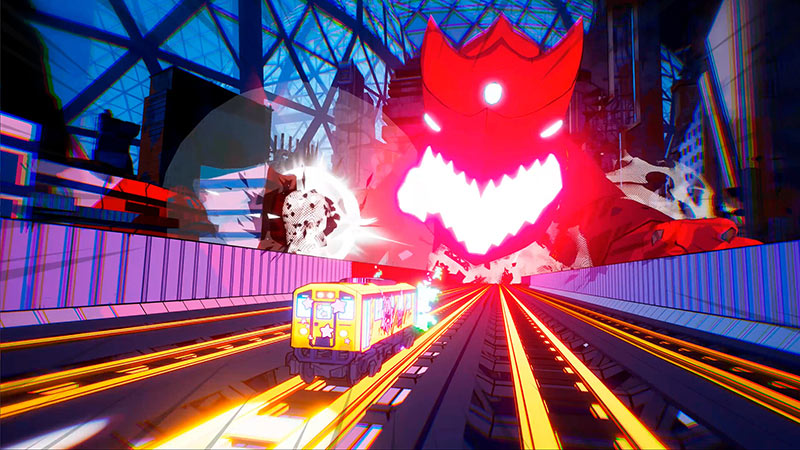
What kind of music does Godzilla groove to? I’m sure something from the Densha soundtrack!
repip: I know Denshattack! just came out, but do you have already a vision for the new game? Is it already in development, or are you still fully committed to Denshattack! ?
Undercoders: For the first time in the history of the studio, we didn’t already have another project planned while finishing the previous one. Denshattack! became so large and ambitious that all our efforts went into completing and polishing it.
That doesn’t mean we’re short of ideas! We would love to continue expanding the world of Denshattack! through updates or additional content if the game is well received. Many mechanics, modes and story ideas were left behind during development and could be interesting to revisit, and we’re eager to further expand the game in future updates, especially after the good feedback received!
repip: Thank you very much for this interview on behalf of myself and the readers of retronagazie.eu, I wish Denshattack! a successful reception in the gaming community! Thanks again for creating this masterpiece! It reminded me of so many great games and mechanics from the old days, all while maintaining its own unique style— I am happy when playing this game, and have no intention of hiding it!
Undercoders: Thank you so much for your kind words and for spending so much time with the game! Hearing that Denshattack! reminded you of those classics while still feeling like something of its own means a lot to us.
We put many years of work and a great deal of ourselves into the project, so knowing that somebody is simply having fun and feeling happy while playing it is probably the best response we could hope for :)
